Flyers made with free AI tools: why they always lack personality
More and more freelancers and small businesses in the Vaucluse are turning to free AI generators to make a flyer in a few minutes. It’s quick, it costs nothing, and at first glance the result looks fine. But once that flyer ends up in a customer’s hands or in a shop window, something feels off: it doesn’t look like anything in particular, and above all, it doesn’t look like you. Here are the problems I come across most often, and what I do to fix them.
Generic fonts and layouts
Free AI tools draw on a limited stock of fonts and templates. The result: thousands of different flyers that all look the same. No visual signature, nothing that ties the document to your business rather than the one next door.
Colours that don’t match your brand
The palette is chosen by the model based on the prompt, not on your identity. If you already have a logo, a business card or a website with specific colours, a generated flyer next to them creates an instant mismatch, and an image that changes from one medium to the next loses credibility.
A muddled information hierarchy
A good flyer guides the eye: within a second you should know what it’s about, then where, when, and how to get in touch. AI generators tend to put lots of elements on the same visual level: same text size, same weight, no clear priority. Readers no longer know where to look first.
A result not designed for print
A flyer generated for the screen isn’t always set up for paper: resolution too low for a sharp result, margins that leave no safety zone, colours that don’t print the way they look on screen. The printed result is often disappointing compared with the digital preview.
Complete contact details, for credibility
Beyond the visuals, a flyer inspires more trust when it shows complete, clear contact details: business name, address or area served, phone number, email. Free AI generators focus on the image and often leave this information in the background, incomplete or poorly highlighted. Depending on your business, some information may also be required by the regulations of your sector: it’s better to check this with a legal professional or your professional body than to rely on a generic template.
A flyer is often the first physical contact between your business and a potential customer. It deserves to show your face, not artificial intelligence’s.
Starting from your image, not from a ready-made template
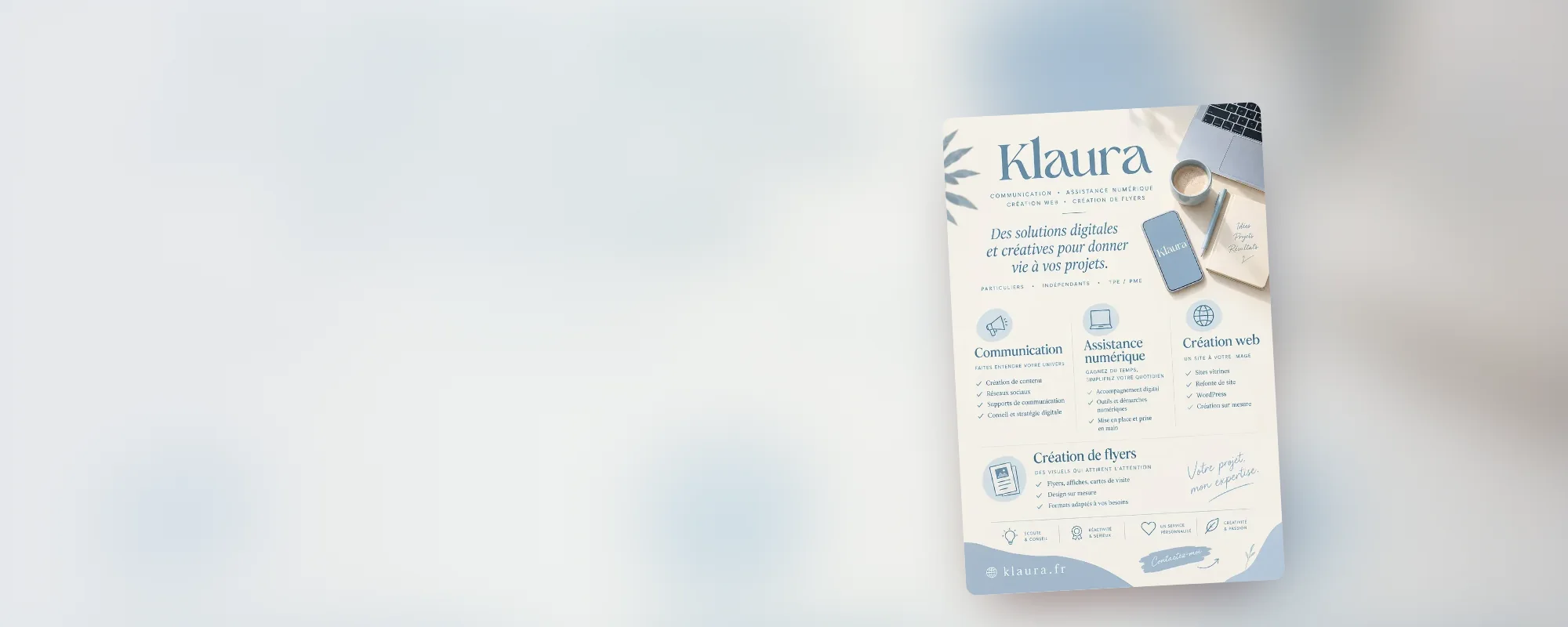
When a client comes to me with an AI-generated flyer that no longer works for them, I don’t just touch up what’s there: I start again from what really represents them, their logo, colours, font and tone of voice. The message stays the same, but the flyer finally becomes recognisable, consistent with their business card, website and social media.
It’s this consistency, across print, the web and communication as a whole, that makes customers remember you rather than your competitor.